
Delicatessen | Gourmet Food

Delicatessen | Gourmet Food

There are 16 products.

Showing 13-16 of 16 item(s)

Active filters

  • Categories: Honey
  • Categories: Syrup
  • Availability: In stock
Elderflower syrup 500ml...

Elderflower syrup 500ml...

... tastes very refreshing and is not too sweet. The syrup can be diluted with water as desired - our suggestion: 1:7.<br /><br />Ingredients: 60% elderflower extract (water, high proportion of elderflowers), sugar, juice of the Northern Lemon (Chaenomeles japonica or also Cido).<br /><br />Depending on the weather (autumn must be warm, otherwise the harvest will fail), the black and blue elderberries are sometimes also made into syrup and fruit spreads.<br /><br /><br />Info on the Nordic lemon<br />The Nordic lemon contains more vitamin C than the conventional lemon. Temperatures as low as -40°C are no problem for them. That is why it is ideally suited for cultivation<br />in our fields. Originally it comes from Latvia, where it is still cultivated and used today as 'the' lemon. Its fruit is very acidic and not suitable for immediate fresh<br />consumption. We use the juice of the Nordic lemons as a substitute for citric acid, which is partly produced artificially. The plant of the Nordic lemon blossoms fiery red from<br />April to June and has a refreshing fragrance. The fruits are harvested in mid-October.<br /><br />Average nutritional values per 100ml<br />Energy: 680kJ/160kcal<br />Fat: &lt; 0,5g<br />thereof saturated fatty acids: &lt; 0,1g<br />Carbohydrates: 40g<br />thereof sugar: 40g<br />Protein: &lt; 0,5g<br />Salt: 0.10g<br />
Price €7.20
Bienenhof Eucalyptus Honey...

Bienenhof Eucalyptus Honey...

Amber-coloured honey, smells rather untypically of wet leaves, liquorice or dried mushrooms, tastes malty-spicy like caramel. Originates from eucalyptus trees, which are<br />very common in the Mediterranean region.<br /><br />Plattner Bienenhof Eucalyptus Honey comes from the eucalyptus trees, which are very common in the Mediterranean region, and it tastes unusually spicy-malty like<br />caramel or cappuccino. On the nose, the honey is rather atypical with notes of dried mushrooms, wet leaves and liquorice. Eucalyptus honey crystallises quickly and then<br />changes colour to beige-grey. Like the essential oils of the plant, our Plattner Bienenhof eucalyptus honey is used to treat colds and respiratory infections. It is also exciting<br />to combine eucalyptus honey with ripened cheese: sheep's milk or Parmigiano, for example.<br /><br />On average, honey contains about 17-19% water, about 70% simple sugars (carbohydrates in the form of glucose and fructose), about 2.5% sucrose, about 0.1% other<br />sugars and about 8% other substances. These naturally occurring components are: Acids, lactones, mineral salts, proteins, amino acids, vitamins, colloids and aromatic<br />substances.<br /><br />Honey, with about 300 kilocalories per 100 grams, is an energy-rich natural product, quickly digestible and well and rapidly absorbed by the body.<br /><br />Honey is a living food!<br /><br />It is even said to have some interesting positive properties on the human body: sedative (calming), antiseptic (germicidal), antianemic (increases red blood cells), diuretic<br />(increases water excretion), and many more.<br /><br />The freshly harvested honey is liquid, but can crystallise over time. This process is quite natural and the crystallised honey can be liquefied again in a warm water bath (up<br />to 40° C).<br /><br />Honey is not suitable for children or babies under 12 months.<br /><br />Country of origin: Italy<br />
Price €13.60
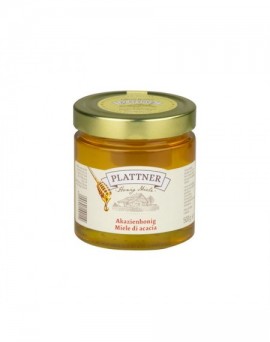
Bienenhof Acacia Honey 500g...

Bienenhof Acacia Honey 500g...

Pale often yellowish-golden honey, smells sweet and unobtrusive, reminiscent of vanilla in the mouth, is obtained from the nectar of the (often) white robinia flowers.<br /><br />Our Plattner Bienenhof Acacia Honey is harvested from the large (often) white flowers of the false acacia (robinia). Its mildly fine, sweetish taste is reminiscent of vanilla and<br />its smell of fresh beeswax and delicate flowers. Acacia honey is very popular with children, suitable as a sweetener and remains liquid for a long time. Our Plattner<br />Bienenhof Acacia Honey comes from natural, intact forests.<br /><br />On average, our honey contains approx. 17-19% water, approx. 70% simple sugars (carbohydrates in the form of glucose and fructose), approx. 2.5% sucrose, approx.<br />0.1% other sugars and approx. 8% other substances. These naturally occurring components are: Acids, lactones, mineral salts, proteins, amino acids, vitamins, colloids<br />and aromatic substances.<br /><br />Honey, with about 300 kilocalories per 100 grams, is an energy-rich natural product, quickly digestible and well and rapidly absorbed by the body.<br /><br />Honey is a living food!<br /><br />It is even said to have some interesting positive properties on the human body: sedative (calming), antiseptic (germicidal), antianemic (increases red blood cells), diuretic<br />(increases water excretion), and many more.<br /><br />The freshly harvested honey is liquid, but can crystallise over time. This process is quite natural and the crystallised honey can be liquefied again in a warm water bath (up<br />to 40° C).<br /><br />Honey is not suitable for children or babies under 12 months.<br /><br />Country of origin: Italy<br />
Price €11.70
Mixed nuts in mild-fine...

Mixed nuts in mild-fine...

Mixed nuts in mild-fine acacia honey.<br /><br />Hazelnuts, walnuts, almonds and cashews and delicious acacia honey combine to create a high-quality, deliciously natural treat. The delicate aroma of the nuts harmonises<br />perfectly with this selected acacia honey, which is never overpowering and scores with its natural sweetness.<br /><br />Origin: Hungarian acacia honey, hazelnuts and almonds from California, walnuts from Chile and cashews from Vietnam.<br />
Price €11.70